Description
Rainy Day in Philadelphia
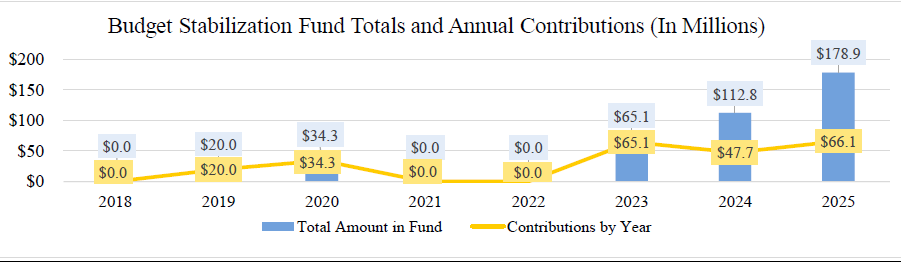
In times of economic downturn, governments turn to savings, commonly referred to as “Rainy Day Funds” to help offset revenue shortfalls, absorb unexpected costs, and maintain essential services. Philadelphia’s Budget Stabilization (Rainy Day) Fund was created through a voter-approved amendment to the City Charter in 2011.
However, mandatory contributions were not required until 2023. Since then, the Fund has grown steadily and is projected to reach a balance of $178.9 million by the end of FY25. Under the proposed Five-Year Plan, the balance is expected to grow to $344 million by FY28, nearly doubling its current balance.
The city’s Rainy Day Fund policy links contributions directly to fiscal performance rather than setting fixed annual deposits. Contribution levels are determined by comparing the projected General Fund Balance to projected General Fund Revenues. For FY25, the General Fund Balance was $1.179 billion and the General Fund Revenue was $6.52 billion, resulting in a Fund Balance percentage of 18.1%. The Rainy Day Fund policy establishes the following contribution tiers:
- If the Fund Balance percentage is projected to be 3% or less, no contribution is required.
- If the percentage is greater than 3% but less than 5%, the city must deposit 0.75% of the projected revenue into the Rainy Day Fund.
- If the percentage is at least 5% but less than 8%, the city must deposit 1% of the projected revenue into the Rainy Day Fund.
- When the projected Fund Balance exceeds 8%, the city must deposit the amount that exceeds the 8% threshold or 1% of projected revenues, whichever is greater, into the Rainy Day Fund.
This structure allows contributions to grow during stronger fiscal years while preserving flexibility when resources
are tighter. The use of reserves during the COVID-19 pandemic reinforced the value of maintaining dedicated savings
to help stabilize city finances during periods of financial stress.
Reserve practices vary considerably across peer cities. While some jurisdictions maintain formal Rainy Day Funds, others rely on reserve balances or stabilization accounts. New York City maintains reserves totaling approximately $2 billion, however a $1 billion withdraw of those reserves has been proposed. Chicago’s reserve fund carries a balance of $50 million, and while not charter-established, it is recognized in the city’s financial reporting. Baltimore County maintains a Revenue Stabilization Reserve with a balance of approximately $257 million and directs unanticipated one-time revenues to the fund until it reaches a minimum target equal to 8 percent of annual operating expenditure.
Each month Controller Brady looks forward to bringing transparency and accountability of our city, right to you.